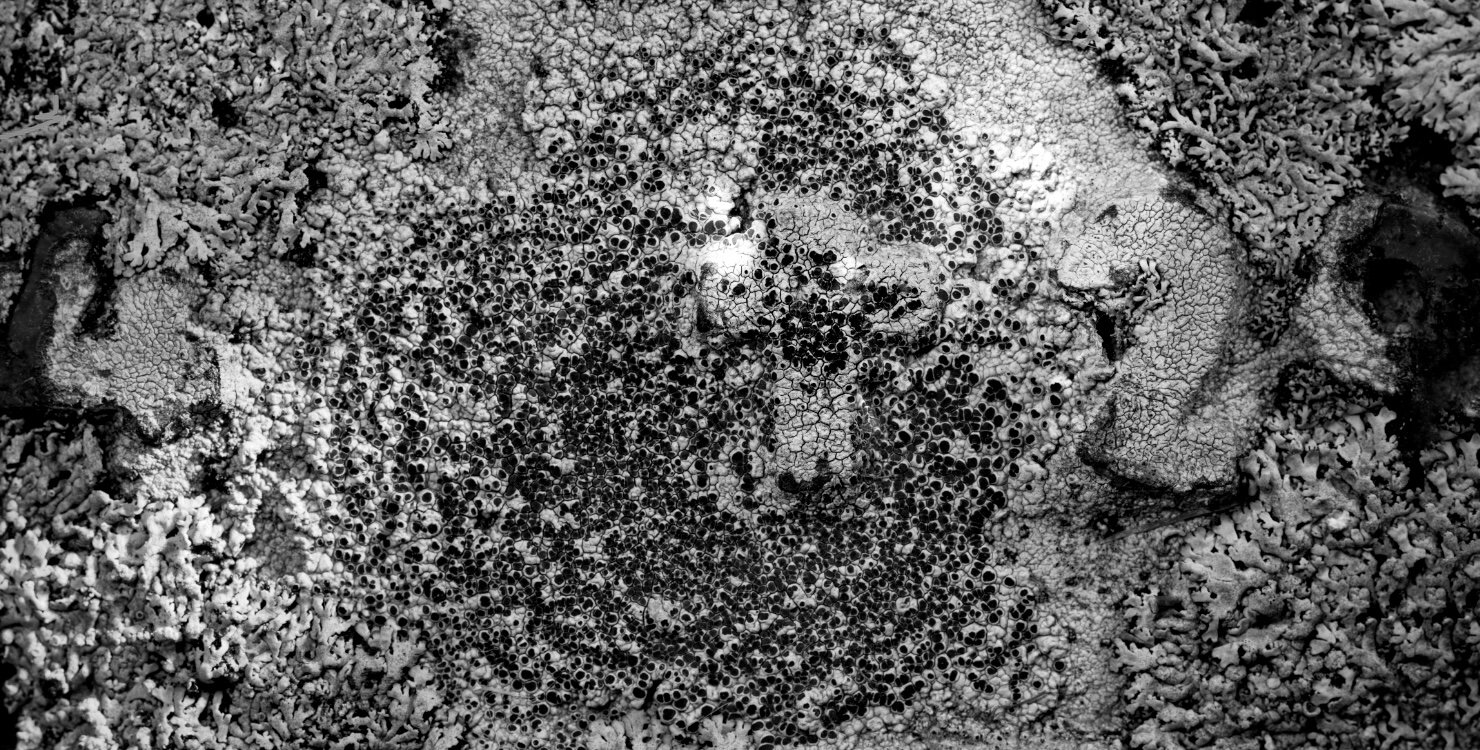
Mysterious green cavities…
Review by Janna Reinsma in de Volkskrant
Oscar Furbacken’s piece in Rotterdam featured as ARTWORK OF THE WEEK in de Volkskrant 27th January 2026!
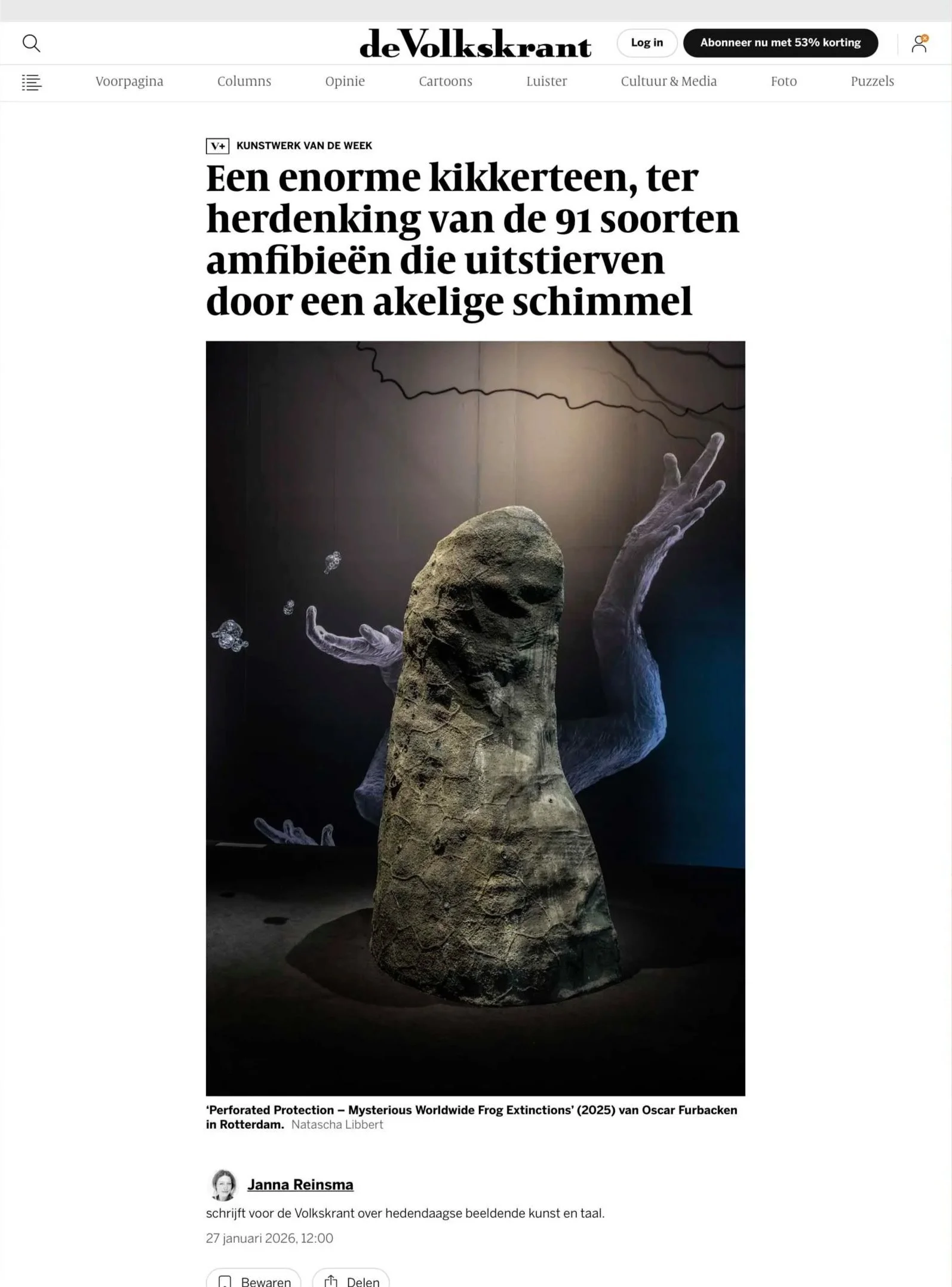
A huge frog toe, in memory of the 91 amphibian species that went extinct because of a horrific fungus
A fungus spread by humans pierced the skin of the corroboree frog, causing it to die out. Oscar Furbacken created an enormous frog toe as a tombstone for the 91 species of frogs, toads, and salamanders that met the same fate.
An intriguing, mossy mountain towers above visitors at the Nieuwe Instituut in Rotterdam. The green surface shows all kinds of patterns and holes, allowing you to look inside, where you see mysterious green cavities.
What is it? It is an extremely enlarged version of a frog toe, made by the Swedish artist Oscar Furbacken (born 1980). More precisely: a toe from a baby specimen of the so-called corroboree frog, a huge photograph of it is also displayed on the wall of the museum gallery. The sad thing is that this beautiful frog has gone extinct, due to a fungus spread by humans that pierces the skin of amphibians. Hence the holes.
The artwork is part of the spectacular exhibition “Fungi – Anarchist Designers”, in which artists and designers, together with scientists, make clear how omnipresent and untamable fungi are, and how ignorant and careless people often are in dealing with them.
That is particularly true in this case. Anyone who walks around the toe discovers on the back a stone grave monument bearing the names of no fewer than 91 species of frogs, toads, and salamanders that have gone extinct since the 1970s because of the same extremely deadly fungus. That is deeply sad in itself, and ecologically disastrous, given the role these animals play in the food chain.
A few hundred metres further on in Rotterdam’s Museumpark, in the Kunsthal, a very different green body part can be seen. It is a cast of a human hand, by the English artist David Shrigley (born 1968).
In the accompanying text next to the artwork, titled *Homemade Dog Toy*, you can read that Shrigley made this cast of his hand in 1995. “I didn’t have a dog myself at the time, so it was chewed on by a friend’s spaniel.”
In the exhibition where the hand is shown, titled *What the Hell Was I Thinking?*, it becomes clear that Shrigley does not shy away from failure. On the contrary, he seems to sum up life as a series of things that didn’t quite work out. Rarely has anyone engaged in such cheerful anti-marketing at their own exhibition.
Next to a series of deliberately clumsy drawings he adds the remark: “I enjoy the discomfort of a bad drawing.” And about the cast of the hand he continues: “It is very badly made, with a lousy mix of materials: latex mixed with acrylic paint and filled with plaster. Over the past thirty years it has certainly deteriorated. When I think back, it didn’t actually look that great even then.” And: “In the 1990s I often used worthless materials to make things. Much of what I made back then is now falling apart.”
It is clear that Furbacken’s green artwork and Shrigley’s green artwork have nothing to do with each other. But in another way, they do. Both artworks show that we humans sometimes—often—don’t quite know what we’re doing. And they almost seem to be waving at each other: the extinct frog and the not-quite-successful human, with a pierced toe and a beautiful, poorly made hand.
/Janna Reinsma, 2026
art critic, writer for de Volkskrant (Netherlands National Press)